
What are the daily maintenance methods for three-wheeled motorcycles? Do these things well, and your car will last longer and have fewer breakdowns.
In daily use, three-wheeled motorcycles are widely used in many scenarios such as rural farming, transporting goods to the market, short-distance freight transportation, construction site transfers, home travel, etc. due to their strong load capacity, stable driving, wide adaptability to road conditions, and high practicality. Vehicles travel on rural dirt roads, country lanes, and uneven roads all year round. With frequent loads and complex road conditions, they are prone to problems such as component wear, reduced power, increased fuel consumption, difficulty in starting, and ineffective braking.
Many car owners only know how to use their cars, but ignore basic maintenance. Small problems can turn into major failures, which not only increases the repair cost, but also affects driving safety and shortens the service life of the entire vehicle. In fact, three-wheeled motorcycles do not require complicated and delicate maintenance. Mastering simple and practical daily maintenance skills and insisting on regular inspection and maintenance can make the vehicle have sufficient power, smooth driving, and durability, and reduce the occurrence of breakdowns and parts damage on the way. The following is a detailed summary of the complete set of daily maintenance methods for three-wheeled motorcycles, from basic inspection to detailed maintenance, explained one by one.
1. Engine maintenance, vehicle power core maintenance
The engine is the heart of a three-wheeled motorcycle and is also the top priority for maintenance. Especially for vehicles that are often heavily loaded for climbing hills, the engine load is greater, so maintenance is particularly critical.
Change engine oil regularly
Engine oil can lubricate, cool down, clean the internal parts of the engine, and reduce wear on the pistons and crankshaft. After the running-in period of a new car is over, the engine oil needs to be replaced in time. For subsequent daily use, every 1,500 miles of driving ~2000 Change the oil once every kilometer. Car owners who frequently use their vehicles with heavy loads, running on dirt roads, or in high-temperature environments are advised to shorten the replacement cycle appropriately. When filling engine oil, choose a matching model and keep the oil volume between the upper and lower scales of the oil dipstick. It should not be too much or too little. Low-quality engine oil will directly aggravate engine wear.
Clean air filter
The countryside is dusty and the dirt roads are very dusty. The air filter element can easily be clogged with dust and debris, causing poor air intake, weakened power, increased fuel consumption, and carbon deposits in the engine. In daily riding, simply clean the dust on the filter element every other week. After cleaning and drying the sponge filter element, apply special engine oil. If the paper filter element is too dusty, replace it directly to ensure smooth air intake and protect the internal parts of the engine.
Check spark plug
The spark plug is responsible for ignition and starting. Carbon deposits, moisture, and abnormal gaps will lead to difficulty in starting, unstable idling, and inability to refuel. Take it out for daily inspection, clean the carbon on the surface, and adjust the ignition gap. If the electrode is seriously worn and cannot ignite, just replace it directly.
2. Brake system maintenance to ensure driving safety
Three-wheeled vehicles carry a larger load, and the burden on the braking system is much higher than that of two-wheeled vehicles. Once the brakes fail, the risk is extremely high, and brake maintenance must be a daily focus.
Check brake fluid and brake pads
For oil brake types, check the brake fluid level regularly. If the oil level is too low, replenish the brake fluid of the same type in time. Check the oil pipe for oil leakage and air intake.; For drum brake types, check the brake pad wear regularly. When the wear becomes thinner and the brakes are weak, adjust the brake gap or replace the brake pad in time.
Keep brake components clean
When riding on dirt roads, it is easy for dirt and dust to enter and adhere to the brake drum and brake disc, which will cause brake slip and poor braking effect. Clean the brake parts regularly and wipe them dry after driving on rainy days to prevent parts from rusting and corroding.
Notes on daily use
Avoid slamming on the brakes continuously for a long time, and drive at a slow speed when going downhill with a heavy load to reduce high-temperature losses of the brake system and extend the service life of the brakes.
3. Transmission and wheel tire maintenance
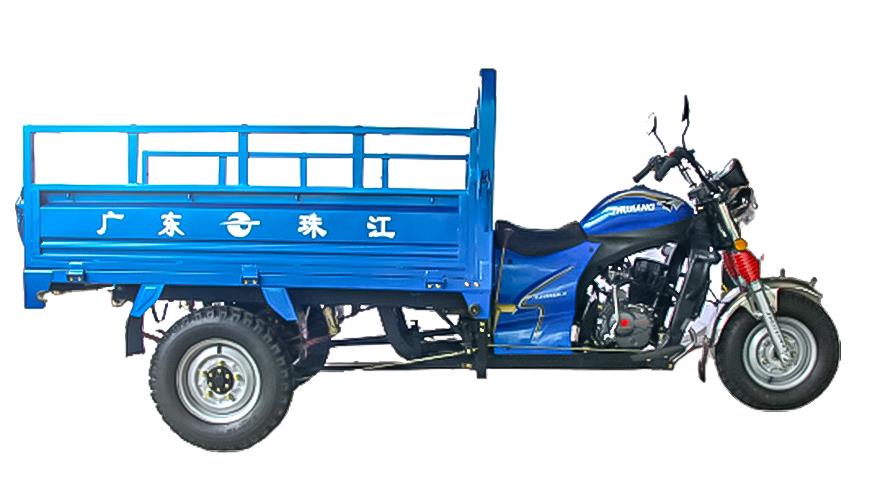
A three-wheeled motorcycle has a main wheel, left and right auxiliary wheels, and a chain drive. The tires and transmission parts wear out quickly, which directly affects the driving stability.
Daily inspection and maintenance of tires
First, check the tire pressure. The front and two rear tire pressures should be even and sufficient. If the tire pressure is too low and heavy load is applied, it will easily crush the tires, increase fuel consumption, and cause the vehicle to deviate.; If the tire pressure is too high, the tire will blow out due to bumps. At the same time, clean the gravel, glass, and hard debris in the tire tread, and check whether the tires are cracked, bulged, or seriously worn. The rear wheels wear faster as load-bearing wheels. If they are found to be aging and damaged, replace them in time. When parked for a long time, support the vehicle as much as possible to avoid long-term stress deformation of the tires.
Chain and drive shaft maintenance
For chain drive models, clean and lubricate the transmission chain regularly to prevent the chain from drying out, rusting, looseness and elongation. A chain that is too loose will easily fall off and get stuck, and a chain that is too tight will aggravate bearing wear. Adjust the tightness regularly. For shaft drive models, check the transmission shaft and differential gear oil, and replace the gear oil regularly to ensure smooth transmission of the rear axle.
4. Routine maintenance of battery circuit
Battery failure is a common minor problem for tricycles. It often occurs in winter when it is difficult to start, the light is weak, and the electric vehicle cannot start due to power loss.
Routinely check whether the battery terminals are loose, oxidized and rusty. If white oxide appears, wipe it clean with hot water, apply Vaseline to prevent further corrosion, and tighten the terminals.
If the vehicle is parked without riding for a long time, it is recommended to start the vehicle idling for a few minutes to charge every other week to avoid long-term battery loss and aging. At the same time, check the entire vehicle wiring, lights, and horn wiring to see if there are any cracks, wear, or short circuits in the wiring to prevent potential leakage and spontaneous combustion.
5. Inspection of body, frame and fasteners
Three-wheeled motorcycles often haul goods and travel on bumpy roads, and the screws on the body can easily loosen and fall off.
Make a brief inspection before each trip to check the frame, handlebars, rear axle, compartment, shock absorber, and wheel fixing screws. If any looseness is found, tighten it in time. After using the car in rainy or humid environments, simply wipe the body to prevent the frame and metal parts from rusting. Check the welding points and connections of the carriage regularly for cracks, and pay more attention to the stability of the frame when using heavy-duty vehicles.
6. Fuel and oil line maintenance (for fuel tricycles only)
For gasoline three-wheel motorcycles, daily oil circuit maintenance must be done. When refueling, choose regular oil to avoid oil circuit blockage and carburetor fouling caused by inferior gasoline. If the vehicle is not used for a long time, try not to store oil for a long time to prevent the gasoline from deteriorating. Clean the carburetor regularly to avoid oil line blockage, poor oil supply, unstable idling, flameout and other problems.
7. Daily riding and parking maintenance habits
New vehicles and vehicles after overhaul must strictly abide by the running-in period and do not slam the accelerator, overload or drive at high speeds for long distances.
Do not overload the vehicle for a long time in daily use. Exceeding the rated load of the vehicle will seriously damage the engine, rear axle, tires and frame.
When parking your vehicle, try to choose a location that is dry, ventilated, and protected from rain and sun to avoid exposure to the sun and rain, which will accelerate the aging of the vehicle body.
After starting a cold car in winter, warm it up by idling for a while before driving to reduce cold engine wear.
Summarize
Three-wheeled motorcycles may appear to be durable, but in fact they are inseparable from simple daily maintenance. No professional equipment is required, and most maintenance work can be completed by car owners themselves. Doing a good job in basic tasks such as oil replacement, filter cleaning, brake inspection, tire maintenance, battery maintenance, and screw tightening can not only greatly improve vehicle driving safety, reduce fuel consumption and failure rates, reduce maintenance costs, but also effectively extend the service life of the vehicle. Whether it is used for home transportation or cargo operations, it can be smooth and durable.
- How to choose the gear of a three-wheel motorcycle according to road conditions 2026-04-22
- What is the relationship between the gear position and fuel consumption of a three-wheeled motorcycle? 2026-04-22
- When to use low speed and when to use high speed on a three-wheeled motorcycle? 2026-04-22
- Three wheel motorcycle 125 /150/175/200cc How to choose displacement? An article to understand without stepping into pitfalls 2026-04-22
- Choose the right three-wheel motorcycle for both practicality and peace of mind 2026-04-22
- What are the daily maintenance methods for three-wheeled motorcycles? Do these things well, and your car will last longer and... 2026-04-22
- Break the prejudice! These usage scenarios of three-wheeled motorcycles hide the practical wisdom of ordinary people. 2026-04-22
 Contact Customer Service
 Home
Home
 Tel
Tel Email
Email Message
 Contact